
Ionian Islands: The Greece Most Americans Skip (And Shouldn’t)
Ask ten Americans to picture Greece and nine will describe Santorini. White houses, blue domes, a cruise ship parked in the caldera. Fair enough. It’s on every screensaver.
But there’s another Greece on the west coast, and it looks nothing like that. The Ionian Islands are green. Really green. Think cypress trees, olive groves that go on for miles, and water so blue it looks edited. The towns lean Italian, with pastel walls and bell towers, because Venice ran the place for about four hundred years.
So here’s what I found after sorting through the islands one by one: they aren’t interchangeable. Each one has its own mood. Pick the wrong one and you’ll still have a good trip, but pick the right one and you’ll be planning your return before the ferry leaves.
So, Where Are We Talking About?
The islands sit in the Ionian Sea, off the western side of mainland Greece, facing Italy’s boot heel. Greeks call them the Eptanisa, which just means “seven islands.” There are plenty of smaller ones too, but seven get top billing.
- Corfu (Kerkyra)
- Paxos
- Lefkada
- Kefalonia
- Ithaca
- Zakynthos (Zante)
- Kythira
Kythira is the odd one out. It sits way down south, off the tip of the Peloponnese, and it’s actually run from the Attica region these days. Most travelers stick to the other six, and that’s what most of this guide covers.
Why the Ionian Islands look so different from Mykonos
Two reasons: rain and history.
The west side of Greece gets far more winter rain than the Aegean. That’s a bummer in January, but it’s why the hills stay green all summer while the Cyclades turn brown and rocky.
And then there’s the history. Venice held Corfu from 1386 to 1797. After that came the French, a short-lived republic, and then the British, who stayed until the islands joined Greece in 1864. You can still see all of it. Corfu’s Old Town, a UNESCO World Heritage Site since 2007, has Venetian fortresses, a French-style arcade, and a cricket pitch. Yes, cricket. They sell ginger beer there too.
One sad footnote. A huge earthquake in 1953 flattened most buildings on Kefalonia, Zakynthos, and Ithaca. That’s why so many towns there look newer than you’d expect. Fiskardo, on Kefalonia’s northern tip, mostly survived, and it’s lovely.
Which Island Fits You? Here’s the Cheat Sheet
Look, I can’t tell you which one is “best.” That depends on whether you want nightlife or naps. But this table should narrow it down.
| Island | Rough size | Known for | Good fit for |
|---|---|---|---|
| Kefalonia | About 300 sq mi | Myrtos Beach, Melissani Cave, Mount Ainos, Robola wine | Road trippers, couples |
| Corfu | About 235 sq mi | Old Town, Paleokastritsa, Achilleion Palace | First-timers, history buffs, families |
| Zakynthos | About 155 sq mi | Navagio (Shipwreck) Beach, sea turtles, Blue Caves | Beach lovers, party crowds in Laganas |
| Lefkada | About 115 sq mi | Porto Katsiki, windsurfing at Vasiliki | Drivers, water sports fans |
| Kythira | About 110 sq mi | Waterfalls, quiet villages, a hilltop castle | People who hate crowds |
| Ithaca | About 37 sq mi | Home of Odysseus, Vathy and Kioni harbors | Hikers, sailors, readers |
| Paxos | About 10 sq mi | Olive groves, tiny harbors, day trips to Antipaxos | Slow travelers |
Corfu: the easy first pick
Corfu is the one with the most going on. It has a real city, a busy airport, and enough beaches to keep you moving for two weeks. The Old Town is a maze of narrow lanes with laundry hanging overhead, and honestly, getting lost there is half the fun.
If you’ve watched The Durrells in Corfu on PBS, you already know the vibe. The family really did live here in the late 1930s.
Kefalonia: big, quiet, and kind of dramatic
Kefalonia is the largest of the bunch, and you’ll need a car. The payoff is big scenery. Myrtos Beach sits under white cliffs that look like somebody cut them with a knife. Melissani is an underground lake where the roof caved in ages ago, so sunlight hits the water around midday and turns it electric blue.
Mount Ainos tops out above 5,300 feet and is covered in a dark fir found nowhere else. It’s a national park, and on a clear day you can see neighboring islands from the top.
Zakynthos: famous for one photo, good for more
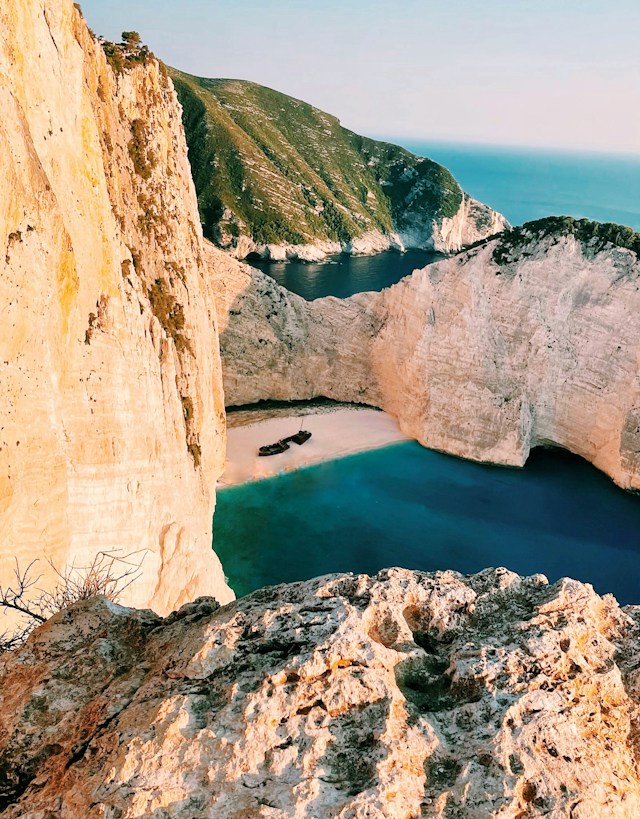
You’ve seen Navagio Beach. It’s the cove with the rusty freighter, the MV Panagiotis, which ran aground in 1980. But there’s a catch. Access to the sand has been restricted in recent years because of rockfall risk, so check the current rules before you book a boat tour around it.
The southern bay is a nesting ground for loggerhead sea turtles and is protected as a national marine park. Nesting runs roughly May through August. Be the tourist who follows the rules there.
Lefkada, Ithaca, and Paxos: the quieter trio
Lefkada has a neat trick: you can drive to it. A causeway and a floating bridge connect it to the mainland, so no ferry needed. The west coast beaches, Porto Katsiki especially, are the kind you see on postcards.
Ithaca is small, hilly, and sleepy. This is Odysseus country, the home he spent ten years trying to get back to. Spend an afternoon in Kioni and you’ll get why he bothered.
Paxos is tiny. Three harbor villages, a whole lot of olive trees, and not much else. That’s the point. Boats run over to Antipaxos, where Voutoumi Beach has water like a swimming pool.
How Do You Even Get to the Ionian Islands From the US?
Here’s the thing: there are no nonstop flights from the States to any of these islands. You’ll connect, usually through Athens or a big European hub like London, Frankfurt, or Rome. From Athens, the hop to Corfu, Kefalonia, or Zakynthos takes about an hour.
Corfu, Kefalonia, Zakynthos, and Kythira have their own airports. Lefkada uses Aktion Airport near Preveza, a short drive away on the mainland. Ithaca and Paxos have no airport at all, so you finish the trip by boat.
Ferries fill in the gaps. Boats run from Igoumenitsa to Corfu, from Kyllini to Zakynthos and Kefalonia, and from Corfu down to Paxos. Schedules thin out a lot outside summer, so check them before you lock in your plans.
A few practical things to sort out before you go:
- Greece uses the euro, and cards work almost everywhere, though small tavernas and beach bars sometimes prefer cash.
- US citizens can visit for up to 90 days without a visa, but check whether the EU’s ETIAS travel authorization applies to your dates.
- Outlets are the two-round-pin European type at 230 volts, so pack an adapter.
- Greeks drive on the right, same as home, but island roads are narrow and twisty. Rent a small car.
When Should You Go? (Hint: Not Just August)
August is hot, packed, and pricey. It’s also when half of Italy shows up. If that’s your only window, fine, you’ll still have a great time. Just book early.
The sweet spots are late May through June and September into early October. The sea stays warm well into fall because it’s had all summer to heat up. As I write this in October, people are still swimming, though some hotels and beach bars are already closing up for the year.
| Season | What it’s like | Heads-up |
|---|---|---|
| April to May | Wildflowers, mild days, Greek Easter celebrations | Sea is still chilly; some places not open yet |
| June | Warm, long days, everything open | Prices start climbing |
| July to August | Highs often in the upper 80s or hotter, lively nights | Crowds, peak rates, hard-to-find rental cars |
| September to early October | Warm sea, thinner crowds, softer light | Ferries and flights get cut back late in the season |
| November to March | Rainy, quiet, very local | Most tourist businesses are closed |
Corfu’s Easter deserves a quick mention. On Holy Saturday, locals throw big clay pots off their balconies into the street. It’s loud. It’s chaotic. People travel from all over Greece to see it.
Okay, But What’s for Dinner?
The food here isn’t quite what you get at your local Greek diner. That Venetian influence shows up on the plate too, and Corfu in particular has dishes you won’t find in Athens.
- Pastitsada: slow-cooked beef or rooster in a spiced tomato sauce, served over thick pasta.
- Sofrito: thin slices of veal in a garlicky white wine and parsley sauce.
- Bourdeto: fish stewed with a serious amount of red pepper.
- Kefalonian meat pie: meat, rice, and herbs baked in a crust.
- Robola: a crisp white wine from Kefalonia’s high vineyards.
- Kumquat liqueur: Corfu’s bright orange souvenir, sweet enough to make your teeth hurt.
And a small tangent, because it matters. Greeks eat late. Show up at a taverna at 6 p.m. and you’ll be eating alone with the staff. Nine o’clock is normal. Order a few plates for the table, take your time, and nobody will rush you with the check. You have to ask for it.
A Few Honest Downsides
I said these islands are underrated, and they are. But they’re not empty. Europeans have been coming here for decades, and parts of Corfu and Zakynthos are built up with package resorts and bars that could be anywhere. If that’s not your scene, it’s easy to avoid. Just know it exists.
Island hopping is also slower than you’d think. The islands look close on a map, but direct ferries between them are limited, and some routes run only in summer. Two islands in a week is comfortable. Four is a headache.
And the roads. Kefalonia and Lefkada have cliffside drives with hairpin turns and the occasional goat. Beautiful, yes. Relaxing, not so much.
Quick Answers Before You Book
How many Ionian Islands are there?
Seven main ones: Corfu, Paxos, Lefkada, Kefalonia, Ithaca, Zakynthos, and Kythira. There are also many smaller islands and islets around them.
Which Ionian island is best for first-time visitors?
Corfu is the easiest start. It has the most flights, a walkable historic town, and a wide range of beaches and hotels.
Can you fly directly from the US?
No. You’ll connect through Athens or another European city, then take a short flight or a ferry.
Do I need a car?
On Kefalonia and Lefkada, pretty much yes. On Corfu it helps a lot. On Paxos and Ithaca you can get by with taxis, boats, and your feet.
Is English widely spoken?
Yes, especially in hotels, restaurants, and shops. Learning “efharisto” (thank you) still earns you a smile.
Are the beaches sandy or pebbly?
Both. Many of the famous ones, like Myrtos, are white pebbles, so water shoes are a smart buy. Sandy beaches are easier to find on Corfu and southern Zakynthos.
How many days do I need?
Give one island at least four or five days. For two islands, plan on a week to ten days so ferry time doesn’t eat your trip.
So, Is It Worth the Extra Flight?
I think so. The Ionian Islands take a little more effort to reach than the big-name spots, and that’s part of why they still feel relaxed. You get green hills, clear water, Venetian towns, and food with its own accent.
Pick one island that matches your pace. Maybe two. Go in June or September if you can, rent a small car, and eat dinner late. That’s really the whole plan.
And if you end up on a harbor in Ithaca with a glass of Robola, watching the boats come in, you’ll understand why Odysseus fought so hard to get home.

Leave a Reply