
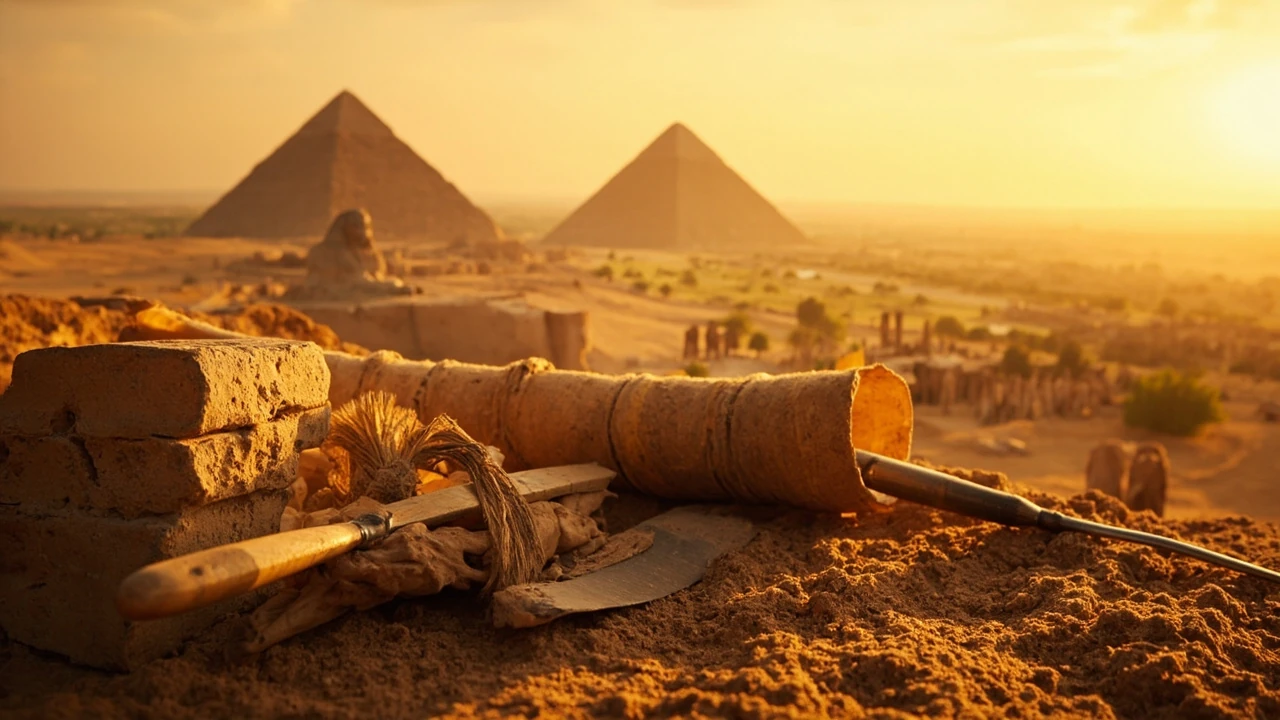
Ancient Egypt timeline: the major eras at a glance
The ancient Egypt timeline is easiest to understand as a sequence of periods in which the Nile Valley became more politically centralized, prosperous, and ambitious. It began with scattered farming communities, passed through powerful Old, Middle, and New Kingdom eras, and continued under Libyan, Persian, Greek, and Roman rulers. The key is to remember that these boundaries are historical models rather than perfectly synchronized calendars.
For travelers, this chronology is more than a list of dates. It explains why a pyramid represents an Old Kingdom state project, why a temple may combine the styles of several periods, and why objects from one era can be found in a city founded during another. It also clarifies that “ancient Egypt” was not one static civilization with a single culture or style.
Most chronological charts use BCE, meaning “before common era,” while older books often use BC. Both labels count backward from the traditional starting point of the Common Era. Dates marked with “circa,” or about, should be treated as approximations. Even the beginning of dynastic Egypt, commonly placed around 3150 BCE, represents a gradual political transition rather than a single documented day.
| Period | Approximate dates | What changed | Landmarks and figures |
|---|---|---|---|
| Predynastic Egypt | Before about 3150 BCE | Farming communities developed along the Nile, followed by increasingly organized villages, trade, craft production, and political leadership. | Badarian and Naqada cultures; early symbolic writing |
| Early Dynastic Period | About 3150–2686 BCE | Upper and Lower Egypt were consolidated under royal rule, with Memphis developed as an administrative center. | Menes, possibly Narmer; early royal tombs at Abydos |
| Old Kingdom | About 2686–2181 BCE | Central administration expanded, monumental architecture flourished, and royal authority became deeply embedded in religion and government. | Djoser; Sneferu; Khufu; Giza pyramids and the Great Sphinx |
| First Intermediate Period | About 2181–2055 BCE | Political authority fragmented and the established balance of centralized government weakened. | Competing rulers and reduced royal control |
| Middle Kingdom | About 2055–1650 BCE | Egypt reunited, the administration recovered, and literature, irrigation, and temple building developed. | Mentuhotep II; Amenemhat I; Senusret III; the Faiyum projects |
| Second Intermediate Period | About 1650–1550 BCE | Egypt divided again, while foreign rulers established footholds in parts of the country. | Hyksos presence in Lower Egypt; the Theban–Hyksos transition |
| New Kingdom | About 1550–1069 BCE | Egypt gained wide international influence, expanded into Nubia and the Levant, and entered its most celebrated imperial phase. | Ahmose; Hatshepsut; Thutmose III; Akhenaten; Tutankhamun; Ramesses II; Ramesses III |
| Third Intermediate Period | About 1069–664 BCE | Power shifted among rulers based in different regions, and Egypt entered its final native dynasty before Persian conquest. | Twenty-first through twenty-fifth dynasties |
| Late Period | About 664–332 BCE | Native dynasties gave way to Persian rule, followed by the arrival of Alexander the Great. | Twenty-sixth Dynasty; Achaemenid Persians; Alexander |
| Ptolemaic and Roman Egypt | About 332 BCE–30 BCE and beyond | Greek rulers governed Egypt for centuries before Rome annexed the country. | Ptolemaic dynasty; Cleopatra VII; Roman province of Egypt |
How historians divide Egypt’s long chronology
No surviving modern calendar reproduces an official Egyptian calendar for the entire ancient period. Modern scholars therefore divide history according to changes in political structure, royal dynasties, material culture, and written evidence. The division into stable “kingdoms” separated by “Intermediate Periods” remains useful because it highlights both Egypt’s capacity for reunification and the recurring political fragmentation that followed weak or disputed reigns.
The dynastic system also depends on a later source. The priest Manetho, writing during the third century BCE, grouped kings into thirty dynasties. His list is not preserved in a complete original form, but later writers preserved enough information for his framework to remain influential. Modern dates can therefore look precise on a chart while resting partly on later testimony, archaeology, and comparison with foreign records.
Several practical conventions help prevent confusion:
- BCE dates run backward. A date in 1550 BCE is earlier than a date in 664 BCE.
- A regnal year is not automatically a modern calendar year. A king’s first year was the start of a reign, not necessarily January 1.
- “About” is meaningful. Rulers’ reigns often contain a core period supported by evidence surrounded by less certain dates.
- Period labels describe patterns, not sealed boxes. Art, building, administration, and regional traditions frequently overlapped.
- Different rulers can claim the same period. The Theban king Ahmose, for example, is commonly associated with the end of Hyksos control, while the early New Kingdom still included a period of adjustment.
For a museum visit, this framework provides more than labels. It helps explain why officials described as “Old Kingdom” may look different from “New Kingdom” artisans, and why a single site may contain evidence from several centuries. It also encourages visitors to distinguish the date of an object from the date of the building that once held it.
From Nile settlements to the first dynasties
Before large kingdoms appeared, communities along the Nile developed the habits that made centralized government possible. The fertile floodplain supported agriculture, while predictable river behavior encouraged cooperation over irrigation, storage, and land management. Settlements also exchanged materials with neighboring regions, including obsidian from Ethiopia and products obtained through contacts with the Levant and Mesopotamia.
The For additional context, historical background of this Nile civilization shows how environmental conditions, farming communities, trade, writing, and royal administration developed over long periods. Early cultural groupings such as Badarian and Naqada are identified through material remains including ceramics, tools, jewelry, palettes, and changes in settlement patterns. These names help archaeologists describe gradual development, but they should not be treated as fixed nations with modern borders.
Near the end of the Predynastic period, signs that had served symbolic or administrative purposes developed into a more formal writing system. This was one of the foundations of dynastic government because writing allowed information about land, labor, taxes, ritual, and royal authority to travel farther and survive longer. It also made kingship visible in texts, monuments, seals, and ceremonies.
Around 3150 BCE, Upper and Lower Egypt were brought together under a king conventionally called Menes. The ancient royal author Manetho credited Menes with unification, although no contemporary account survives. Many scholars identify Menes with Narmer, a ruler known from artifacts associated with early dynastic kingship. The For additional context, historical background of this Nile civilization shows how environmental conditions, farming communities, trade, writing, and royal administration developed over long periods. Early cultural groupings such as Badarian and Naqada are identified through material remains including ceramics, tools, jewelry, palettes, and changes in settlement patterns. These names help archaeologists describe gradual development, but they should not be treated as fixed nations with modern borders.
The Early Dynastic Period established institutions that later kingdoms inherited. Memphis offered access to the Delta and important trade routes, while Abydos developed as a center connected with early royal mortuary traditions. Mastaba tombs, royal seals, reliefs, and administrative records all presented the king as the organizer of the ordered world.
- Neolithic and early farming communities: Settlements and herding developed along the Nile Valley.
- Badarian culture: Communities developed distinctive ceramics, copper tools, ornaments, and burials.
- Naqada phases: Larger settlements, wider trade, better tools, and early administrative symbols emerged.
- Late Predynastic transition: Writing and large-scale political organization developed alongside expanding leadership.
- Unification: A king linked Upper and Lower Egypt and established institutions centered on royal authority.
Old Kingdom: building the first great royal state
The Old Kingdom, usually dated from about 2686 to 2181 BCE, is the period most closely associated with the pyramids. Increasing agricultural production supported a more elaborate administration, specialized workforces, and large construction projects. Kings presented themselves not only as political rulers but as central participants in the maintenance of cosmic and religious order.
Djoser, associated with the step pyramid complex at Saqqara, became the first ruler of the Third Dynasty. He commissioned major building projects and helped establish the visual and institutional conventions of kingship. Sneferu, the founder of the Fourth Dynasty, sponsored major construction and is linked with both unsuccessful and successful pyramid projects. Khufu then became associated with the Great Pyramid at Giza, while his successor Khafre built the second pyramid and the Great Sphinx.
These monuments should not be imagined as isolated creations by single individuals. Their construction depended on surveying, quarrying, transport, food supply, housing, administration, skilled craftspeople, and labor systems whose precise organization remains debated. Evidence includes quarry workers’ settlements, tools, stone blocks, administrative records, and the physical remains of the monuments themselves. The scale is certain; every detail of how the labor force was assembled is not.
The Old Kingdom also developed distinctive visual forms. Royal sculpture emphasized idealized bodies, stable poses, and recognizable conventions. Administrative texts and elite tombs provided glimpses of how officials imagined an ordered society. These sources are invaluable, but they mostly describe the experiences of people with enough status to commission monuments or records. Farmers, laborers, and many others left fewer direct accounts.
Over time, the centralized system became costly to sustain. Succession crises, changing conditions, and the demands of royal institutions contributed to a decline in effective authority. The result was not the disappearance of Egyptian culture. It was a weakening of the older balance among kingship, provincial administration, and agricultural resources, leading into the First Intermediate Period.
First and Second Intermediate Periods: division, recovery, and new power
The First Intermediate Period, commonly placed around 2181–2055 BCE, was marked by weaker central coordination and competing centers of authority. “Intermediate” does not mean that nothing happened. Farming, craft work, temple activity, art, and regional government continued. The difference was that large kingdoms no longer exercised the same effective control over the entire Nile Valley.
Political recovery began under rulers based at Thebes. The Eleventh Dynasty brought the south under stronger control and eventually reunified Egypt. Its most significant ruler was Mentuhotep II, whose reign marked the restoration of a unified monarchy and the beginning of the Middle Kingdom. The transition was not a single battlefield victory; rebuilding administration, restoring confidence in royal rule, and persuading local institutions to cooperate were equally important.
The Middle Kingdom, dated approximately from 2055 to 1650 BCE, is often associated with political stability and cultural revival. Literature, including narrative tales and instructional texts, flourished. Irrigation expanded, including state-supported development in the Faiyum region. The Twelfth Dynasty founded a new royal residence at Lisht and produced large building projects, while rulers such as Amenemhat I, Senusret III, and Amenemhat III strengthened the administration and developed fortified border zones.
This era also saw Egyptian influence extend farther into Nubia, a region of strategic importance along the Nile. For additional context, Trade and military activity connected Egypt to territories to the south, while royal monuments asserted control over distant landscapes. These developments continued a longer process of interaction rather than a simple boundary between “Egypt” and “Nubia.”
The Second Intermediate Period followed, conventionally dated around 1650–1550 BCE. Egypt divided again into Hyksos-controlled Lower Egypt and a Theban kingdom in the south. The Hyksos, whose origin lay in the broader Levant and whose political center was at Avaris, introduced technologies and military practices that became part of Egyptian royal culture. Their rule was not simply a foreign occupation in every respect; power operated through local institutions and continued traditions.
The chronology therefore moves through a recurring cycle:
- Central authority weakens or becomes disputed.
- Regional rulers gain practical influence.
- Economic and military competition changes foreign relations.
- A new coalition or dynasty reunifies the country.
- The reunited state usually expands or redefines its frontiers.
New Kingdom: expansion, empire, and religious change
The New Kingdom began around 1550 BCE. The exact starting point varies slightly among chronologies, but the period usually spans from about 1550 to 1069 BCE. It included Egypt’s greatest territorial reach, its most ambitious rulers, and major changes in religion and art. It was also the point at which Egyptian power became deeply entangled with the political systems of the eastern Mediterranean and Nubia.
Ahmose I is commonly credited with driving the Hyksos from Avaris and establishing the Seventeenth Dynasty as the foundation of the New Kingdom. The Eighteenth Dynasty then moved rapidly from consolidation to expansion. Hatshepsut, one of Egypt’s most powerful female rulers, sponsored extensive building and trade expeditions. Under Thutmose III, Egyptian campaigns extended its influence into the Levant, while the Amarna-period king Akhenaten introduced a new royal religious emphasis centered on the Aten and moved the royal capital to Akhetaten, now associated with Tell el-Amarna.
Akhenaten’s religious reforms were controversial, and the evidence suggests that the traditional cults of Amun and other gods were not simply erased overnight. After his death, Tutankhamun restored older religious practices and relocated the court to Memphis. The later Eighteenth Dynasty included extensive military campaigns under Ramesses II, whose name appears on monuments across Egypt and whose reign included a major conflict with the Hittite Empire.
Egypt’s imperial reach did not guarantee permanent control. Political influence depended on alliances, tribute, rival powers, and the ability to protect distant territories. Ramesses III, the major ruler of the Twentieth Dynasty, defended Egypt against invasions associated with the Sea Peoples and consolidated control over parts of Nubia and the Levant. After his death, political fragmentation increased, although the royal institution and its foreign relationships continued.
New Kingdom art and archaeology should be read with care. Amarna art often departs from earlier conventions, producing elongated bodies and intimate domestic scenes. Royal monuments are political documents as well as works of art: their scale and imagery communicate the ruler’s relationship to gods, enemies, and the ideal order. A damaged image can still be historically informative, and an apparently simple object may have been removed from its original context by later collectors or archaeologists.
Third Intermediate and Late Periods: power changes hands
The Third Intermediate Period, approximately 1069–664 BCE, is often described as a time of shifting authority. Kings ruled from different centers, while provincial governors and military commanders accumulated power. Egypt remained productive and administratively sophisticated, but control was distributed differently from the centralized system of the New Kingdom.
Several dynasties ruled during this period. Libyan ancestry became increasingly prominent among the royal house, and rulers competed for authority through military power, political alliances, and control of key cities. The Twenty-first Dynasty was based at Tanis, the Twenty-second at Bubastis, and the Twenty-third had a center at Leontopolis in the Delta, with important rulers including Takelot II and Shoshenq III. Nubian rulers such as Piye and Shabaka also gained prominence, while the Twenty-fifth Dynasty ruled from Napata and then Memphis.
The Twenty-sixth Dynasty brought a renewed native Egyptian dynasty and greater international involvement. Its rulers, including Psamtik I, used diplomacy, mercenaries, and royal diplomacy to limit the ambitions of Assyria and maintain Egyptian independence. The period also included significant cultural exchange. Greek merchants and settlers became increasingly visible, especially at sites such as Naukratis, although their presence did not make Egypt Greek at this stage.
Assyrian invasions in the seventh century BCE weakened Egypt, and the country eventually came under Persian rule. Achaemenid Persian kings administered Egypt as part of a larger empire, using local institutions and royal traditions to some extent. Persian control ended when Alexander the Great defeated the Persian Empire and entered Egypt in 332 BCE.
After Alexander’s death, Ptolemaic rulers governed Egypt from a Greek Macedonian dynasty. Their capital was Alexandria, a city that developed into a major center of commerce and intellectual life. Cleopatra VII was the last ruler of the Ptolemaic dynasty. Her death in 30 BCE led to Roman annexation, after which Egypt became a Roman province and remained under Roman and later Byzantine rule.
This ending should not be read as the day Egyptian culture vanished. Local languages, temple traditions, administrative practices, architecture, and religious life continued under new rulers. Instead, the political framework changed: Egypt ceased to be ruled by its own dynastic kings and became part of larger imperial systems.
How to use the chronology at museums and historic sites
A useful ancient Egypt timeline does not attempt to memorize every king. Instead, use it to connect a place, object, or inscription with a larger political setting. Start with the period, then identify the ruler or dynasty, and only afterward move into finer details such as a specific battle, building stage, or family relationship.
For example, the Great Pyramid belongs to the Old Kingdom and the Fourth Dynasty, not simply to a vague category of “pyramid age.” A tomb from the New Kingdom may reflect a burial practice shaped by earlier royal traditions, but its imagery and location often reveal a different relationship between the dead official, the king, and the gods. An object discovered in a much later city may have been made in an entirely different era.
Use the following method when examining an exhibit label:
- Locate the date. Identify whether it refers to manufacture, discovery, reuse, restoration, or the date of the surrounding building.
- Place the date in a period. Early Dynastic, Old Kingdom, Middle Kingdom, New Kingdom, or Late Period.
- Identify the ruler. If the object bears a name, compare it with dynastic lists rather than assuming every royal name indicates a ruler’s actual reign.
- Read the function. A temple, tomb, stela, coffin, tool, and household vessel served different purposes and reached different audiences.
- Consider material and technique. Stone, faience, metal, pottery, pigment, and written media preserve different kinds of information.
- Note later intervention. A monument may have been enlarged, reused, damaged, relocated, or reinterpreted after its original construction.
Visitors should also avoid expecting each period to have one uniform “style.” Regional workshops, individual artists, changes in function, and copying of older models could produce major variation within a reign. Chronology provides the framework, but archaeology supplies the detail.
| Question | Useful chronological clue | Interpretation |
|---|---|---|
| Is this a royal monument? | Names, cartouches, royal scenes, or a named dynasty | It may express official ideology as well as the ruler’s actual power. |
| Is it a tomb or temple? | Location and architectural plan | Its purpose affects how its scenes and texts should be read. |
| Was it made in the period shown? | Material, workmanship, inscription, and scientific dating | Stylistic resemblance alone does not guarantee an early date. |
| Why does it look unlike famous examples? | Regional, private, military, or later-period context | Well-known royal monuments are only a small part of surviving archaeology. |
| Was the site always used for the same purpose? | Multiple construction phases and repairs | Ancient sites accumulated layers rather than remaining frozen in time. |
A timeline becomes even more valuable when used to compare historical experiences with other places. For a broader example of how a modern country’s history is divided into political eras, see Chile history: from the Atacama to today’s republic. Current conditions matter when interpreting travel decisions as well; the site’s Morocco travel safety overview illustrates how practical guidance should be checked for freshness rather than inferred from an old article.
Frequently asked questions
When did ancient Egypt begin?
Ancient Egypt is generally dated from about 3150 BCE, when Upper and Lower Egypt were unified under early dynastic rule. The transition was gradual, so this date marks a convenient division between the Predynastic cultures and the royal state rather than an instant transformation. Farming, craft production, trade, symbolic writing, and regional leadership had developed for many centuries before the first dynasty. This is why the ancient Egypt timeline usually begins with the Predynastic period rather than treating 3150 BCE as civilization’s absolute beginning.
When did ancient Egypt end?
The answer depends on what historians mean by “ancient Egypt.” One endpoint is 30 BCE, when Roman forces annexed Egypt following the death of Cleopatra VII and the end of the Ptolemaic dynasty. Another is 332 BCE, when Alexander the Great conquered Egypt and opened the Hellenistic phase. A broader definition can extend through the Roman and early Byzantine periods because Egyptian institutions and traditions continued. For everyday reference, the clearest conventional boundary is 30 BCE, while the timeline should still explain that political conquest did not erase Egyptian culture.
What are the three main kingdoms of ancient Egypt?
The three major stable kingdoms are the Old Kingdom, Middle Kingdom, and New Kingdom. The Old Kingdom, approximately 2686–2181 BCE, is associated with the formation of a powerful centralized state and monumental pyramid construction. The Middle Kingdom, approximately 2055–1650 BCE, followed a period of division and brought political recovery, literary development, irrigation projects, and stronger connections with Nubia. The New Kingdom, approximately 1550–1069 BCE, brought wider imperial influence, major campaigns, international diplomacy, and dramatic artistic and religious developments.
Who united Upper and Lower Egypt?
Ancient tradition credits King Menes with uniting Upper and Lower Egypt around 3150 BCE. No surviving contemporary narrative records the event, and scholars continue to debate how the unification actually unfolded. Many identify Menes with Narmer, whose royal imagery is connected with early unification. The Narmer Palette, for example, presents symbolic imagery associated with royal authority and the joining of the Two Lands. A careful ancient Egypt timeline therefore distinguishes the traditional name from the modern scholarly identification rather than presenting them as unquestionably identical.
Why are there Intermediate Periods in the chronology?
Intermediate Periods mark intervals when effective authority was divided, weakened, or contested. They occurred after periods of strong central government and before dynasties that reunited much of Egypt. “Intermediate” is a modern label, not an Egyptian one, and it does not mean that the country was empty or that ordinary life stopped. Farming, trade, temple building, art, and local government continued. These divisions are useful because they show that political unification required repeated negotiation among royal authority, regional institutions, military power, and agricultural communities.
Who built the Great Pyramid?
The Great Pyramid at Giza was built for the Fourth Dynasty pharaoh Khufu, generally placed in the late twenty-sixth century BCE. Its construction required quarrying, transporting, and precisely placing enormous quantities of stone, along with housing and feeding a specialized workforce. The ancient Egypt timeline does not need to attribute every task to one imaginative labor category. Evidence indicates an organized project involving skilled and non-skilled workers, supported by the state. Khufu’s reign also belonged to a broader period of royal ideology and monumental construction rather than an isolated building episode.
Was Egypt ruled by pyramids?
No. Pyramids were monuments, not rulers, and they did not function like modern government buildings where laws were routinely administered or stored. They were part of royal mortuary complexes and expressed the pharaoh’s sacred status, relationship with the gods, and concern for preservation beyond death. Most people lived and worked far from the pyramid-building centers, and the visible remains represent only a fraction of Egypt’s settlements, farms, workshops, homes, and regional centers. A timeline therefore places pyramids within broader political and religious systems rather than treating them as the whole civilization.
Did ancient Egyptians build the same kinds of pyramids throughout its history?
No. Pyramid building was concentrated in particular periods, especially the Old Kingdom, although later kings continued to construct royal pyramid complexes in modified forms. Early royal mastabas and step pyramids also differed from the fully developed Old Kingdom pyramids. Later examples generally appear smaller or more elaborately decorated, while most later rulers chose rock-cut tombs rather than monumental masonry pyramids. Understanding the differences helps prevent visitors from treating every pyramid-shaped monument as an Old Kingdom survivor.
How did Egypt maintain control over such a large territory?
Egypt’s strength came from combining several systems: a king at the center, local officials, temples and estates that depended on royal authority, taxation and agricultural surplus, military force, and shared political and religious ideas. Control was strongest along the Nile and weakened with distance, although major routes and frontier zones could be held for long periods. During the New Kingdom, Nubian territories, military installations, diplomacy, and alliances extended Egyptian influence well beyond the core valley. No single mechanism explained the empire; its durability depended on coordination among institutions that operated at different scales.
What is the simplest way to remember the ancient Egypt timeline?
Remember the progression: settlement and writing before dynasties, unification, the Old Kingdom, division and recovery, the Middle Kingdom, another division, the New Kingdom, late native dynasties, Persian rule, Alexander, the Ptolemies, and Rome. The most useful checkpoint names are Narmer, Khufu, Mentuhotep II, Ahmose, Hatshepsut, Akhenaten, Tutankhamun, and Cleopatra VII. These names are not enough by themselves, but they provide anchors for the larger political and cultural changes that appear in the full ancient Egypt timeline.





Leave a Reply