
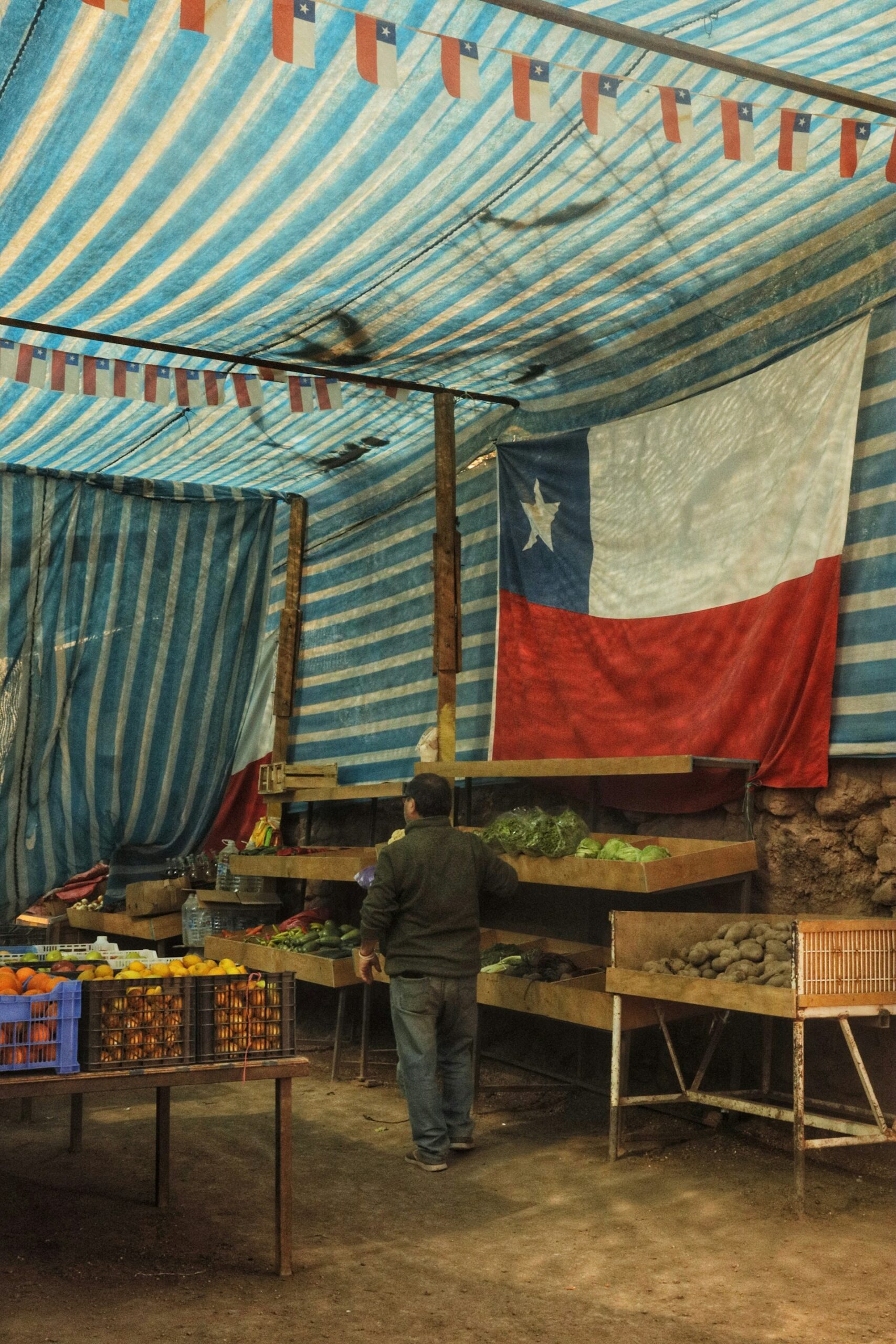
Chile History, Told Like a Road Trip Down a Very Skinny Country
Pull up a map of South America and look at the left edge. See that long ribbon squeezed between the Andes and the Pacific? That’s Chile. It runs about 2,650 miles top to bottom, roughly the distance from New York to Los Angeles, and averages only around 110 miles wide.
That odd shape explains a lot. Desert up north, ice down south, mountains on one side, ocean on the other. For most of its past, Chile was hard to reach and even harder to control. And honestly, that isolation is the thread running through the whole story.
So here’s how it works. We’ll go era by era, keep the dates light, and stop for a few detours along the way.
Where Chile History Really Begins (Hint: Long Before Spain)
People have lived in Chile for a very long time. At Monte Verde, near today’s Puerto Montt, archaeologists found evidence of a human settlement roughly 14,500 years old. That find rattled American archaeology, because it was older than the Clovis sites in New Mexico that textbooks once treated as the starting line.
Then there’s the north. Along the Atacama coast, the Chinchorro people were mummifying their dead about 7,000 years ago. That’s around two thousand years before the Egyptians got started. UNESCO added the Chinchorro sites to its World Heritage list in 2021.
By the late 1400s, the Inca Empire had pushed down from Peru into northern and central Chile. But they stalled. Tradition puts the limit near the Maule River, where the people later known as the Mapuche refused to budge. Remember that name. It comes up again. And again.
Conquistadors, Earthquakes, and a Frontier That Wouldn’t Quit
Diego de Almagro marched down from Peru in 1536 looking for gold. He found cold mountain passes, hostile locals, and not much treasure, so he went back. Pedro de Valdivia had more patience. He founded Santiago on February 12, 1541.
But there’s a catch. Spain never really conquered the south. The Mapuche learned to ride horses, studied Spanish tactics, and fought back hard. A young leader named Lautaro, who had once served as Valdivia’s stable hand, led the forces that killed Valdivia in 1553.
The fighting, known as the Arauco War, dragged on for generations. In 1641, Spain did something it almost never did in the Americas: it signed a treaty recognizing the Biobío River as a border with an Indigenous nation. Think of it as a frontier, a bit like the American West, except the frontier held for more than two centuries.
Meanwhile, colonial Chile stayed poor and remote. It was a backwater of the Viceroyalty of Peru, mostly farms and ranches, regularly flattened by earthquakes. Not exactly the crown jewel of the empire.
How Did a Colony on the Edge of the Map Break Free?
Napoleon helped, oddly enough. When he invaded Spain and knocked the king off his throne, colonies across the Americas started asking who was in charge. On September 18, 1810, leaders in Santiago formed their own governing junta. Chileans still celebrate that date as Fiestas Patrias, with barbecue, kites, and the cueca, the national dance. It’s their Fourth of July, more or less.
The first try didn’t stick, though. Spanish forces won at Rancagua in 1814 and took the country back. So here’s what happened next. Bernardo O’Higgins, the son of an Irish-born Spanish official, teamed up with Argentine general José de San Martín. In early 1817 they led an army over the Andes, a crossing that makes Washington on the Delaware look like a pond hop.
They won at Chacabuco in February 1817. Chile declared independence on February 12, 1818, and the win at Maipú that April sealed it. O’Higgins ran the country until 1823, when he was pushed out and left for Peru.
Here are the names worth knowing from those years:
- Bernardo O’Higgins, the first leader of independent Chile
- José de San Martín, the Argentine general who planned the Andes crossing
- Manuel Rodríguez, a guerrilla fighter and folk hero
- Diego Portales, the minister behind the 1833 constitution
That 1833 constitution matters. While neighbors bounced between coups, Chile settled into a fairly stable, if not very democratic, republic. Stability became part of the national self-image.
Nitrates, Copper, and the War That Redrew the Map
Up north, the Atacama Desert turned out to be full of nitrates, which the world wanted for fertilizer and explosives. Chile, Bolivia, and Peru all had stakes there. A tax dispute lit the fuse, and the War of the Pacific ran from 1879 to 1884.
Chile won big. It took Peru’s Tarapacá region and Bolivia’s whole coastline. Bolivia has been landlocked ever since, and it’s still a sore subject. During the same years, the Chilean army pushed into Mapuche territory in the south, ending that long-held frontier by 1883. And in 1888, Chile annexed Rapa Nui, better known as Easter Island.
Nitrate money poured in. It also caused fights over who got to spend it, which fed a short civil war in 1891. Then German chemists figured out how to make synthetic nitrate, and the boom went bust. You can still visit Humberstone, a nitrate ghost town in the desert. It feels a lot like an old Nevada mining camp.
Copper took over. It still runs the show; Chile is the world’s largest copper producer and one of the biggest lithium producers too.
| Period | Main export | What it meant |
|---|---|---|
| Colonial era | Wheat, hides, tallow | A modest farm economy tied to Peru |
| 1880s to 1920s | Nitrates | Fast wealth, then a hard crash |
| 1920s to today | Copper | The backbone of government revenue |
| 2000s to today | Lithium, fruit, wine, salmon | A wider mix, though mining still leads |
The Part of the Story Everyone Asks About
You can’t talk about Chile without talking about 1973. Let me explain how it got there.
In 1970, Salvador Allende won the presidency. He was a Marxist, and he got there through the ballot box, which was a first for a country with Chile’s democratic record. In 1971, Congress voted unanimously to nationalize the copper mines. Allende also took over banks and sped up land reform.
The economy soon buckled. Inflation soared, shelves emptied, and the country split down the middle. The United States was no bystander, either. The Senate’s Church Committee later documented CIA covert action in Chile during those years.
On September 11, 1973, the military attacked the presidential palace. Allende died inside. General Augusto Pinochet took power and held it for almost 17 years.
The record of that period is grim. Chile’s own truth commissions later recognized more than 3,000 people killed or disappeared and tens of thousands more who were jailed or tortured. Many thousands went into exile.
At the same time, a group of economists trained at the University of Chicago, the “Chicago Boys,” rebuilt the economy around free markets. They privatized pensions, cut tariffs, and sold off state companies. Chileans still argue about that legacy. Growth came, eventually. So did deep inequality. Both things are true, and that’s the mild contradiction at the heart of modern Chile.
Then came the surprise. In 1988, Pinochet held a yes-or-no vote on staying in power. He lost. About 56 percent voted “No.” Patricio Aylwin took office in March 1990, and democracy was back.
Chile History Since 1990: Calm, Then a Jolt
For two decades, Chile looked like the steady kid in the class. Poverty fell sharply. Power changed hands at the polls. Michelle Bachelet became the first woman president in 2006.
Nature kept things interesting, as it always does there. A magnitude 8.8 earthquake hit in February 2010. Months later, 33 miners were pulled alive from a collapsed mine after 69 days underground, and half the planet watched it live. (For the record, the strongest earthquake ever measured also struck Chile: magnitude 9.5, near Valdivia, in 1960.)
Then, in October 2019, a subway fare hike of 30 pesos in Santiago set off huge protests. The slogan said it all: it’s not 30 pesos, it’s 30 years. People were angry about pensions, health care, schools, and the cost of living.
What followed was a long argument over the constitution, which dates to the Pinochet years:
- 2020: nearly 80 percent of voters backed writing a new one
- 2022: voters rejected a left-leaning draft
- 2023: voters rejected a conservative draft too
So the old text, amended many times, is still in force. Gabriel Boric, a former student protest leader, served as president from 2022 to 2026. José Antonio Kast, a conservative, won the December 2025 runoff and took office in March 2026. A big swing, sure. But the handoff was peaceful, and in Chile that counts for a lot.
| Year | Event |
|---|---|
| About 12,500 BC | People living at Monte Verde |
| 1541 | Santiago founded by Pedro de Valdivia |
| 1641 | Spain recognizes the Biobío frontier with the Mapuche |
| 1810 | First national junta, September 18 |
| 1818 | Independence declared |
| 1879 to 1884 | War of the Pacific |
| 1960 | Valdivia earthquake, magnitude 9.5 |
| 1970 | Salvador Allende elected |
| 1973 | Military coup, September 11 |
| 1988 | “No” wins the plebiscite |
| 1990 | Return to democracy |
| 2019 | Mass protests begin in Santiago |
Want to See It for Yourself?
Reading only gets you so far. If you ever fly down, and it’s an overnight haul from most US cities, a few places make the past feel close:
- The Museum of Memory and Human Rights in Santiago, which covers the dictatorship years
- La Moneda, the presidential palace bombed in 1973
- Humberstone, the nitrate ghost town near Iquique
- Rapa Nui, with its moai statues, about 2,200 miles off the coast
- Valparaíso, the old port city of hills and funiculars
And you know what? The wine country tells a story too. Carménère, a grape thought lost in France, turned up alive and well in Chilean vineyards in the 1990s. Isolation again, doing its thing.
Quick Answers to Common Questions
When did Chile become independent?
Chile declared independence on February 12, 1818. The national holiday, though, is September 18, marking the first junta in 1810.
Who lived in Chile before the Spanish arrived?
Many peoples did, including the Mapuche, Aymara, Atacameño, Diaguita, and Rapa Nui, plus groups like the Selk’nam in the far south.
Why is Chile so long and narrow?
Geography boxed it in. The Andes block the east and the Pacific sits to the west. The War of the Pacific stretched the country north.
What was the War of the Pacific about?
Mostly nitrate-rich desert land. Chile beat Peru and Bolivia between 1879 and 1884 and took territory from both.
How long did Pinochet rule?
From the coup on September 11, 1973, until March 11, 1990. That’s about sixteen and a half years.
Was the United States involved in the 1973 coup?
The US worked against Allende through covert action and economic pressure, as Senate investigators documented. Historians still debate how direct its role in the coup itself was.
Does Chile have a new constitution?
No. Voters turned down two proposed drafts, in 2022 and 2023, so the 1980 constitution remains, with many amendments.
So, What’s the Takeaway?
Chile is a country shaped by its edges. The desert, the mountains, and the sea kept it apart, and that distance bred a stubborn streak you can spot in every era: the Mapuche holding their line, O’Higgins crossing the Andes, voters saying “No” in 1988, and voters saying no twice more when they didn’t like the constitutions on offer.
It isn’t a tidy story. There’s pride in it and there’s pain in it, and Chileans themselves don’t agree on how to tell some chapters. But that’s why it matters. A place this far from everywhere has a lot to say about how nations fall apart and put themselves back together.

Leave a Reply